Wine Time at the Schlosshotels
Some stories you read. Others you drink.
From ancient monastery walls to the highest vinothèque in Europe
As summer winds down and nature glows in rich autumn colors, the wine regions enter perhaps the most exciting time of the year: the main and late harvest. It brings not only the best grapes, but also days filled with celebration and enjoyment. Wine festivals fill villages with music and joie de vivre, rustic wine taverns entice with homemade specialties and the young wine, and the first Sturm flows like autumn itself – wild, sweet, alive. This is the season when wine and culture meet in the most sensual way.
Whether high atop a ridge in South Tyrol or deeply rooted in the Styrian Vulkanland Region, the wine world of Schlosshotels & Herrenhäuser is as diverse as the landscapes themselves.
Weingut Winkler-Hermaden combines organic-regenerative farming with social engagement, aging its wines in barriques made from wood harvested in the family’s own forest. Vitikultur Moser represents biodynamic viticulture with Demeter certification, producing distinctive natural wines, while Sepp Perwanger crafts his unmistakable wines at RADOIN 1560, Europe’s highest winery. Weingut Bründlmayer bottles grapes from top vineyards such as Heiligenstein and Käferberg with immense sensitivity and, according to Falstaff, has ranked among Austria’s elite for years. At Schloss Gobelsburg, the oldest winery in the Danube region, a centuries-old winemaking tradition continues – from monastic practices of the 19th century to today’s award-winning dessert wines. And within the Gothic walls of Schloss Englar, elegant Burgundy varieties thrive on calcareous soils, cool nights, and around 1,700 hours of sunshine each year.


Weingut Winkler-Hermaden: 38 hectares of organic-regenerative agriculture
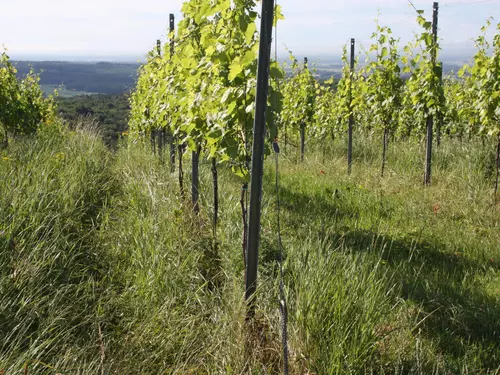
Surrounding Schloss Kapfenstein in Styria, the Winkler-Hermaden family cultivates 38 hectares of vineyards on volcanic tuff – by hand, organically, and according to the regenerative principles of today, enriching the soil and strengthening nature. Alongside classic varieties such as Blaufränkisch, Sauvignon Blanc, and Gewürztraminer, Winkler-Hermaden increasingly focuses on fungus-resistant, so-called PiWi varieties, which allow for especially sustainable cultivation with minimal need for plant protection measures. “I am an organic farmer with all my heart,” says Georg Winkler-Hermaden. “I believe that organic wines will become a given within the next twenty years.”
As a member of Styrian Terroir and Classic Wineries (STK), Winkler-Hermaden is committed to the highest quality standards. With vineyards such as Rosenleiten and Schlosskogel (Erste STK Lage) as well as Kirchleiten (Große STK Lage), the winery manages vineyards that have been officially acknowledged as some of the finest in Styria – where the volcanic origin and terroir of the region unfold with an exceptionally distinctive character.
Barriques from their own forest
The wines are matured in a complex that encompasses the historic Löwenkeller and the modern Drachenkeller – a place, then, where past and present meet in perfect harmony. Alongside traditional large wooden casks, modern stainless steel tanks and a selection of barriques also line the cellars, where particularly expressive reds and select whites are allowed to age. The oak for the small barrels comes from the family’s own forest on the Kapfensteiner Kogel – a closed cycle that literally brings the winery’s deep local roots all the way into the cellars themselves.
Culture, Community, Responsibility
Together with Weltweitwandern Wirkt!, Weingut Winkler-Hermaden is involved with educational projects around the world aimed at giving new opportunities to children and families. Learning from one another. Encountering one another as equals.
This openness is also lived out locally: with exhibitions in their vaulted cellars, music on the terrace, and festive Advent menus, Schloss Kapfenstein becomes a place of exchange throughout the year – and of shared enjoyment. An overview of current and upcoming events can be found here.


Vitikultur Moser: Biodynamic by Design, Naturally Made
For 17 generations, the Moser family has been rooted in viticulture – in Lower Austria’s Kremstal as well as the sunny vineyards of Gols along the shores of the Neusiedler See. Today, Nikolaus Moser operates Vitikultur Moser in Kremstal with a clear focus on biodynamic winemaking practices. All wines are certified organic and, in addition, awarded the rigorous Demeter seal of quality. Some are also produced as natural wines – spontaneously fermented, unfiltered, and unrefined, as close to nature as possible. As a member of the Austrian Traditional Wineries Association (Österreichischen Traditionsweingüter), Moser brings the concept of single-vineyard wines into dialogue with his biodynamic philosophy – a union of origin and conviction that resonates in every glass. “My passion is the vines, and everything that grows, crawls, and flies around them.” – Nikolaus (Niki) Moser
Between Glass and Conversation
In the course of a tasting directly at the winery in Rohrendorf near Krems, biodynamic viticulture is brought vividly to life. Guests are also invited to tour the historic wine cellar, enjoy a glass on the sunny terrace, or immerse themselves in the world of Vitikultur Moser inside the stylish Atrium – very much the architectural heart of the estate.


Weingut RADOIN 1560: Europe’s highest wine cellar at 1,560 meters
Where once an all-terrain vehicle was parked, wines now mature in small oak barrels: in the former garage of the Zirmerhof in South Tyrol, Sepp Perwanger created Europe’s highest winery – RADOIN 1560. Here, the host proudly carries on the vision of his grandfather, Josef Perwanger III, who was already vinifying small batches of grapes back in the 1930s.
Where Depth Comes from Elevation
Shaped by precise craftsmanship, passion, and an uncompromising commitment to quality, Weingut RADOIN 1560 is not about vast volume, but rather about wines of character and depth. The grapes come from select vineyards in Montan along the South Tyrolean Wine Road – including Chardonnay and Gewürztraminer from the Kühmösl vineyard (elev. 400 m), as well as Pinot Noir Riserva from Runggò N° 1 (550 m) and Runggò N° 2 (500 m). The cool climate lends freshness and finesse, while temperature, air pressure, and altitude create ideal conditions for fermentation and maturation.
Those who wish to experience this special place can arrange a cellar tour and discover the quiet, care, and Alpine individuality captured in every glass.


Weingut Bründlmayer: Great Vineyards. Great Names. Great Wines.
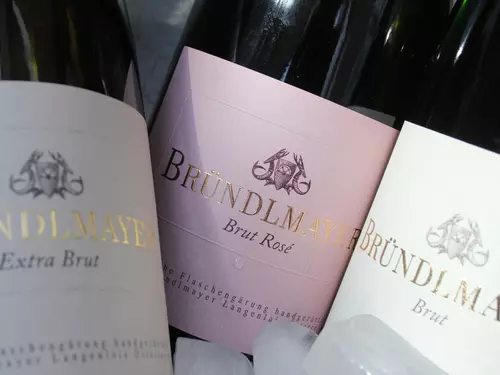
Between Kamptal and the Danube, on barren primordial rock and under the influence of cool nights, Weingut Bründlmayer produces wines of unmistakable character. Willi Bründlmayer and his family cultivate grape varieties of world renown – above all Grüner Veltliner and Riesling, complemented by Grauburgunder, Muskateller, St. Laurent, Zweigelt, and Cabernet Franc. Chardonnay and other Burgundy varieties are considered the estate’s specialties.
Quality with Conviction
For more than 40 years, the winery has worked close to nature and with sustainability in mind – with precision, patience, and respect for all living things. “In wine lies precious truth: it tells of the soil, the heat, the cold, the storm and the rain, of the landscape and also the people it encounters.” - Willi Bründlmayer. Their demanding standards are confirmed by the Falstaff Wine Guide: “Virtually every wine, from the lightest Grüner Veltliner to the reds and even the sparkling wines, has the potential to be the best of its vintage in its particular category.”
ÖTW – Origin as a Promise
The finest grapes come from vineyards including Heiligenstein, Lamm, Loiserberg, Spiegel, Steinmassl, and Käferberg – names known far beyond Austria. As a founding member of the Austrian Traditional Wineries Association "Österreichische Traditionsweingüter" (ÖTW), Bründlmayer is committed to making the interplay of soil, climate, grape variety, and cellar tangible in every wine – a philosophy that unites origin and signature. In collaboration with other renowned estates, the winery has played a decisive role in shaping vineyard classification of the entire Danube region.
These standards are also reflected during vinification: in a multi-level gravity-flow cellar, the wines are processed with particular care – every step carried out as gently as possible.
Experience, taste, linger
At Heurigenhof Bründlmayer – the family’s charming wine tavern-restaurant in Langenlois, with fantastic cuisine and three stylish guest rooms – the philosophy becomes a tangible experience: guests can sample both current wines and matured vintages by the glass. And if you wish, you can even stay overnight.


Schloss Gobelsburg: The journey begins in 1171
Schloss Gobelsburg in Kamptal is one of the oldest wineries in Austria – a place where the history and present of winemaking engage in a lively dialogue. It was all the way back in 1171 when the monks of Zwettl Abbey were granted their first vineyards on the Heiligenstein and Gaisberg. With the acquisition of Schloss Gobelsburg and its surrounding vineyards in 1740, a new era began – one shaped by sensitivity, immense experience, and deep respect for tradition. Since 1996, Michael and Eva Moosbrugger have been leading the winery into the future, borne forward by the history out of which it has grown.
Simplicity, Innovation & the Dynamic Cellar Concept
Inspired by the monastic principle of simplicity, a completely flexible cellaring system was created: instead of mechanically pumping the wines from one zone to another, they are moved on wheels from one to the next. At the heart of this concept is the “barrel on wheels” – an elegant innovation that makes it possible to handle the wine gently while preserving the individuality of each vineyard.
Historical Methods of Winemaking
At Schloss Gobelsburg, vinification has long centered on Grüner Veltliner and Riesling – two grape varieties interpreted here with extraordinary depth and variety. Of special note is the “Tradition” line, in which historical winemaking methods – inspired by monastic practices of the 19th century – are revived and cautiously evolved. Schloss Gobelsburg is also known for its exquisite sweet wines: Grüner Veltliner Eiswein is one of the house specialties, vinified regularly and awarded numerous international prizes.
As a member of Österreichische Traditionsweingüter, Schloss Gobelsburg - like Weingut Bründlmayer and Vitikultur Moser - is committed to the principle of origin and to careful vineyard classification.


Weingut Schloss Englar: Gothic elegance meets unadorned South Tyrolean wine
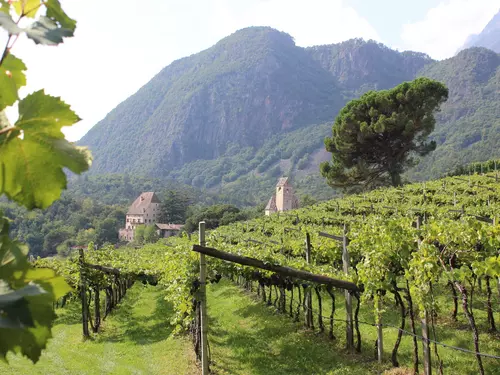
Enthroned high above Eppan on the South Tyrolean Wine Road, Schloss Englar is a late Gothic castle ensemble surrounded by old trees, vines, and one of the most significant surviving castle chapels in South Tyrol. The winery cultivates the largest contiguous expanse of vineyards in Eppan-Berg – an extraordinary terroir that has been dedicated to viticulture for centuries.
The Quiet Pride of the Grape Vines
The vineyards extend from 450 to 550 meters above sea level and provide ideal conditions: nutrient-rich soils, pronounced differences between day and night temperatures, and 1,700 hours of sunshine annually. Combined with a love for the winegrowing craft, they yield wines with layered character and a clear sense of origin. Particular pride is taken in the Burgundy varieties – above all, Pinot Noir and Pinot Blanc – which, in this calcareous terroir, develop a style marked by elegance, finesse, and longevity.
In the cellar, the focus is on spontaneous fermentation, extended lees aging, restrained use of oak, and a conscious renunciation of filtration and fining — a deliberately puristic approach to vinification that allows the wines to reflect the terroir and vintage authentically. The result: characterful, elegant, and long-lived wines with depth, now acclaimed far beyond the borders of South Tyrol.

Wine tells a story. Of hands that harvest with care. Of sun and rain, of storm and stillness. Of soil that sustains, and of patience that allows it to mature. It tells of places rich in history – and of the people who continue to write it. At Schlosshotels & Herrenhäuser, these stories are given the space they need to unfold: quiet in the cellar, alive in the glass, and shared at the table.