Experience
When the hotel itself is the destination
Arrive, immerse yourself, want to stay forever
You arrive intending to explore the surrounding area and soon realize that the real destination is actually right here. In the architecture, in the salons and parlors, within the historic walls, in those artistic details, mature gardens, and hosts who run their houses with unmistakable personality. Guests who stay at Schlosshotels & Herrenhäuser experience the hotel as an integral part of the journey – and, not infrequently, as its most memorable centerpiece.

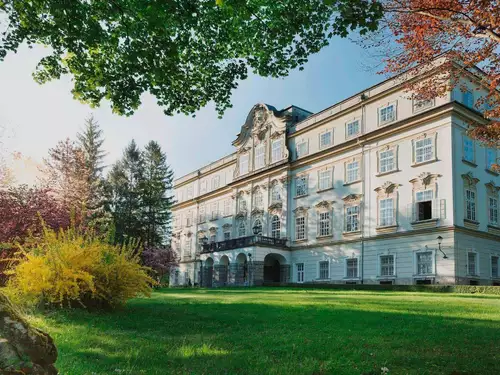
Schloss Leopoldskron: Reside surrounded by Salzburg’s cultural history
The Leopoldskroner Weiher lies peacefully before the Schloss. Beyond this small, idyllic lake are the city of Salzburg, the fortress, and the mountains. Inside, salons, historic rooms, and the Max Reinhardt Library lead visitors through the many eras of the house. They tell the stories of aristocrats, diplomats, musicians, artists, and intellectuals who visited Schloss Leopoldskron over the centuries and helped shape its identity. That connection remains tangible today, as rotating exhibitions and cultural programs bring history and the present day together under one roof. Max Reinhardt, in particular, left his mark here. The theater pioneer and co-founder of the Salzburg Festival transformed Leopoldskron into a nexus of art, conversation, and big ideas.
From Max Reinhardt to Hollywood
Perhaps that is precisely why the Schloss still possesses something theatrical about it. Not because it seeks to grab the spotlight, but because its rooms, light, and history continually open up new perspectives. This cinematic quality has made Leopoldskron the setting for international productions time and again - from Hollywood films and television series to operas, music videos, even fashion shoots. Best known, of course, is its role in The Sound of Music from 1965. Salzburg is close at hand, yet Schloss Leopoldskron has always granted itself the freedom to be more than enough in its own right.


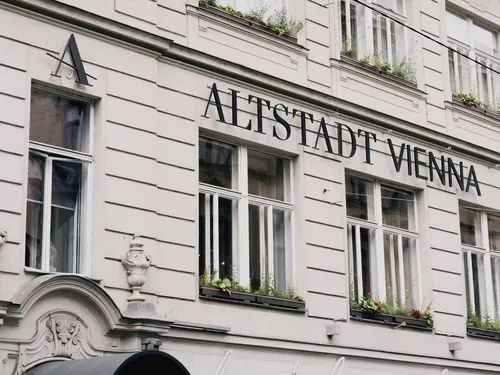
Hotel Altstadt Vienna: Art Gallery with a Room Key
In Vienna's Seventh District, tucked away amidst narrow streets and vibrant city life, Hotel Altstadt Vienna occupies a patrician townhouse dating back to 1902. Vienna begins right outside the door – though it is fair to claim, it already began inside the hotel itself: in the paintings, colors, rooms, and effortless closeness to art that defines this house so completely.
When the room is part of the collection
At Hotel Altstadt Vienna, art does not merely hang on the walls. You live side-by-side with it. Otto Ernst Wiesenthal opened the house in 1991 as a hotel with an art gallery - or perhaps an art gallery with rooms. His collection still accompanies guests through the corridors and guest rooms today, featuring works by Andy Warhol, Brigitte Kowanz, Prachensky, Attersee, Helnwein, and many others.
Then there are the rooms themselves, each feeling like a carefully curated piece in its own right. No two are alike. Architects, designers, and artists have each created their own interpretation of Viennese living at the Altstadt Vienna - among them Matteo Thun, Dietrich Untertrifaller, the design duo Polka, Tobias Moretti, and the Vienna-based studio Archisphere. The latest addition is the Harry K Room Suite, dedicated to actor Harald Krassnitzer and created together with architect Roland Nemetz. The result is a stay that doesn’t demand a guided tour, yet somehow evolves into one time and again: on the staircase, in the salon, in your own room, somewhere between artwork, furniture piece, and an eye for detail.


Schloss Schönbrunn Grand Suite: Night at the Museum
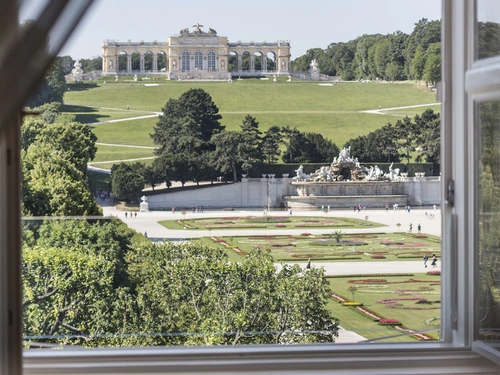
Monument, museum, UNESCO World Heritage Site: Schönbrunn tells stories of Maria Theresa, Franz Joseph, and Elisabeth; of courtly life, representation, and retreat. A visit leads through magnificent state rooms and private apartments, out into the gardens, onward to historic collections, elegant facades and perspectives, and locations that make European history tangible and vibrant. The palace served as the Habsburgs' summer residence, a stage for the monarchy, and a private living space all in one.
When the gates close
When the gates close and the palace grows quieter, perspectives shift. What serves as a public showcase during the daytime becomes your private realm at night. The Grand Suite of Schloss Schönbrunn occupies the eastern wing of the palace itself. Revealing itself on 167 square meters is an exclusive retreat with two bedrooms, a salon, living room, and two bathrooms. A place where, for one night, history is not merely observed but inhabited. The next morning, the park greets you in person before the day officially gets under way. The paths, facades, and gardens feel more familiar because you encounter them not as a visitor, but as a guest of the house. Unhurried, tranquil, accompanied by the feeling of becoming, albeit briefly, a part of this storied history.


Stiegl-Gut Wildshut: Brewing, Baking, Learning, Enjoying
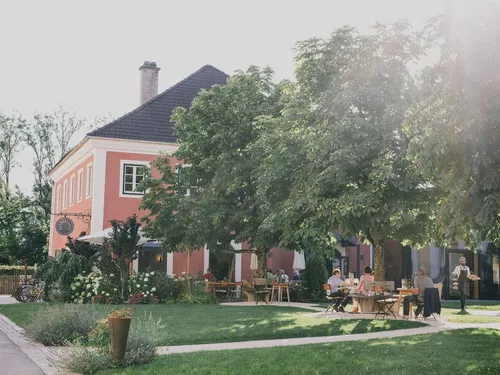
Between fields, orchards, and historic farm buildings lies Stiegl-Gut Wildshut in St. Pantaleon. Austria's first beer estate, Wildshut reveals just how much has to happen before the actual enjoyment begins: in the fields, in the farming, in the malt house and roastery, in the workshops, and at the Einkehr restaurant. What grows here is processed, refined, and ultimately enjoyed in the very place where it originated.
Workshops, Guided Tours, and Bold Flavors
Organic farming has been practiced at the Wildshut since 1994. It forms the foundation for much of what is created here: heritage grains and hops, organic beers and specialty spirits, bread from the Wildshut ovens, and dishes served at the Einkehr. The circular economy celebrated here isn’t some abstract concept. You encounter it on the plate, in the glass, in the aroma of freshly baked bread, and along the paths that wind through the estate.
For guests, Wildshut opens itself on several levels. Guided tours offer insights into grain and hop cultivation, the brewer’s art, and the philosophy behind the estate. The Wildshut Workshops are part of the WILDSHUT CAMPUS and focus on bread baking, beer, mindfulness, and sustainability. Add to that the Wildshut Auszeit brunch, a concert picnic with the Salzburg Philharmonic, the Christmas market, and numerous other events that bring the estate to life throughout the year. Here, farming, craftsmanship, knowledge, and enjoyment come together - from the soil to the table, from the first raw ingredient to lasting impressions: of flavor, comprehension, and a sense of place.

Stiegl-Brauwelt: Museum, Brewery Cinema, and Pure Delectation in Salzburg
After Wildshut, where everything begins in the soil, Stiegl-Brauwelt brings visitors into the city of Salzburg itself, and into the history and present day of brewing. Here, beer becomes tangible as an iconic cultural asset in its own right - through knowledge, craftsmanship, production, and that moment when raw ingredients become manifest in pure flavor.
See, Marvel, Savor
The beer museum explores the history of the Stiegl brewery, its ingredients, brewing expertise, and the evolution of beer making. The 270° Stiegl brewery cinema follows the entire journey, from harvesting the raw materials to bottling. In the in-house brewery, visitors can watch the creative brewers at work, while the brewhouse and bottling hall really bring the production process to life. Whether on a guided tour or with an audio guide, the Brauwelt can be discovered step by step, tastings included.
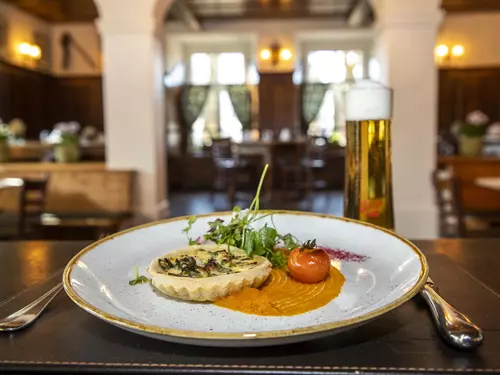
The journey then continues to the table. At the Bräustüberl, the Stieglitz, and the other dining areas, the experience comes to a satisfying conclusion with Austrian cuisine, beer specialties, tastings, and Salzburg hospitality at ist finest. The beer museum, brewery cinema, brewhouse, and bottling hall continue to resonate long after - on the plate, in the glass, and in a deeper appreciation for the craftsmanship and artistry behind it all.


Burg Bernstein: 800 Years of History. And Thousands of Stories.
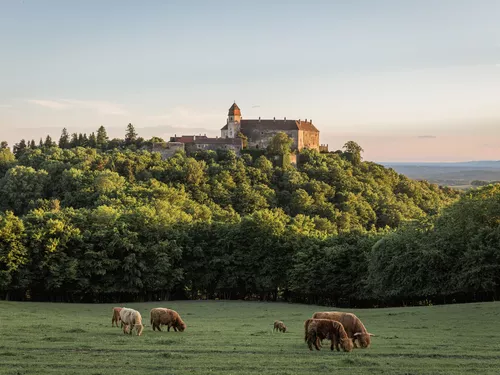
For more than 800 years, Burg Bernstein in Burgenland has been home to countless stories. Those who arrive here do not step into a hotel in the traditional sense, but into a deeply rooted castle complex of walls, courtyards, staircases, and rooms that reveal themselves with every step you take. Much only becomes apparent in the course of a quiet saunter: a remote corridor, a glimpse of the inner courtyard, a detail carved in stone, a story that suddenly appears.
Every nook has a tale to tell
"Every nook has a tale to tell," says Erasmus Almásy, host of Burg Bernstein. Some have become known far beyond the castle walls - such as the story of László Almásy, which later inspired The English Patient. Others remain closer to home: The Sundial, Count Dracula, The Unknown Knight, or The Counterfeiter, whose small prank even made its way onto ORF television. Stories that remain alive to this day. Stories that prompt people to laugh, marvel, and occasionally pause for thought. Because there are hosts here who preserve them and pass them on, giving their guests the chance to become part of them, if only for a moment.
Even today, the historic rooms continue to be filled with life. Concerts take place in the grand hall, joined by workshops and special events that draw upon the character of the house itself. Sometimes the focus is music, sometimes art, sometimes history, and occasionally even courtly dancing with a touch of Jane Austen and Bridgerton.

These are houses worth traveling for in their own right. Because they, themselves, raise each day to perfection: with rooms, gardens, stories, hosts, and unique moments that can only be experienced there. Places that have grown over time, been lived in, and continue to be shaped by people who understand exactly what makes their house so special.