In the Footsteps of Clemens Holzmeister
An architectural journey through Austria
Architecture. Culture. Extraordinary Houses.
City journeys can be experienced in many ways. Sometimes they lead from landmark to landmark, sometimes from café to museum, from street to square. This journey follows a different perspective – an idea of architecture that sharpens the eye for what emerges between façades, squares, and spaces, shaped by a personality who always saw the building, people, and surroundings as one: Clemens Holzmeister.
Clemens Holzmeister is considered one of the most influential Austrian architects of the 20th century and one of the foremost creators of monumental and sacred architecture of his era. Over the course of his long life, he designed more than 650 projects in Austria and abroad, most of which were ultimately realized. Holzmeister understood architecture as a connecting force between simplicity and expressiveness. Between tradition and modernity. And it is precisely here that the connection to Schlosshotels & Herrenhäuser becomes visible: historic houses that have not stood still, but rather continue to evolve. Places where history, the present, and lived experience intertwine naturally. Places that themselves become part of the journey.
Our journey leads from Vienna via Salzburg and St. Anton am Arlberg to Dürnstein – revealing new ways to experience cities, architecture, and extraordinary houses.


Vienna: Origins, Thought, and Architecture in Practice
Vienna is the beginning. It was here that Clemens Holzmeister studied, taught for decades, and shaped generations of architects. The city was simultaneously his intellectual home, workshop, and stage. His also made his early architectural breakthrough here: in the form of the Simmering Crematorium, inaugurated in 1922 – located adjacent to the Central Cemetery in Vienna – first gaining wide-spread recognition for his achievement. The building exemplifies his understanding of architecture: clear, dignified, and powerful without resorting to pathos.
Yet for Holzmeister, Vienna was not only a place for him to construct buildings, but rather to shape in a far broader sense. In 1934/35, he served as City Councilor for the Arts and as a member of Vienna’s civic assembly, participating in numerous major construction projects throughout Austria in this role. Anyone exploring Vienna in his footsteps encounters not a single icon, but an urban fabric interweaving history, culture, and architectural conviction. Two of our houses are located right at its heart – offering very different ways to experience the life and thinking of Clemens Holzmeister.
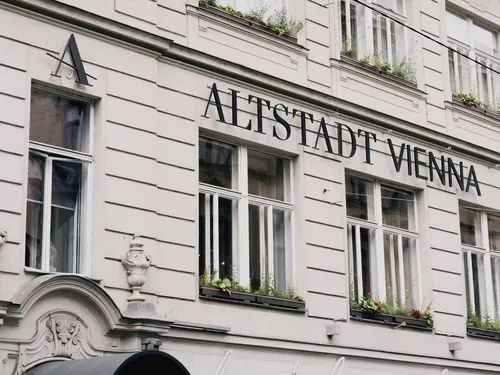
Art, Design & Architecture – the very DNA of Hotel Altstadt Vienna
Hotel Altstadt Vienna sees itself as an art and design hotel where architecture represents an integral part of its identity. Rooms and suites have been created by renowned architects, artists, and designers – including figures such as world-famous architect Matteo Thun, contemporary fashion designer Atıl Kutoğlu, and Atelier Olschinsky. A house that allows its spaces to tell their own stories. A house that exemplifies the dialog between past and present – just as Clemens Holzmeister continually sought to achieve.
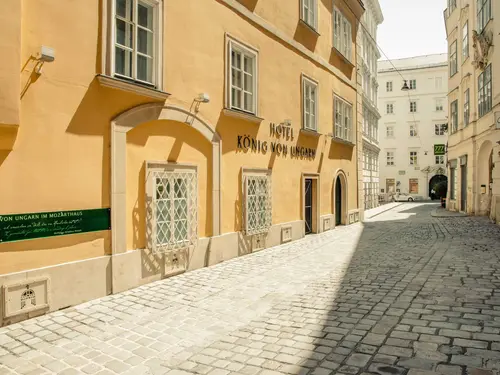
Hotel König von Ungarn between City Streets, History & Architecture
A visit to Vienna in Holzmeister’s footsteps means learning to see. Paying attention to proportions. To transitions. To the interplay between old and new. In this way, Vienna is not merely visited, it is understood. Hotel König von Ungarn lies at the heart of this urban fabric. Part of the cityscape for centuries, the house has witnessed change while preserving continuity – and serves as an ideal starting point for discovering Vienna step by step as a city of architecture and history.


Salzburg: From Stairway and Stage to Honorary Citizen of the City
Salzburg thrives on powerful images – and on the quiet architectural interventions in between. The Clemens Holzmeister Stairway is one of them: a functional yet carefully designed transition that skillfully connects movement, space, and city. Created in 1937 during the expansion of the Kleines Festspielhaus used by the Salzburg Festival, it now leads along the façade of the stage building and stands as a prime example of Holzmeister’s dialogical understanding of architecture.
Yet Clemens Holzmeister shaped Salzburg far beyond this single intervention – particularly through his close collaboration with the Salzburg Festival. For Max Reinhardt’s legendary 1933 production of Faust, he designed the so-called Faust City in the Felsenreitschule. Two decades later, a Don Giovanni City followed at the same venue for Mozart’s Don Giovanni under the direction of Wilhelm Furtwängler. Architecture became both stage and space – and thus part of the theater itself.
With the construction of the then “Neues,” now “Grosses” Festspielhaus in 1960, his collaboration with the Salzburg Festival reached its zenith, leaving behind one of his central works in the city. Here, Holzmeister saw architecture as the underlying framework for art and culture: present, yet never dominant. In recognition of his contribution, he was ultimately named an honorary citizen of the City of Salzburg in 1976.
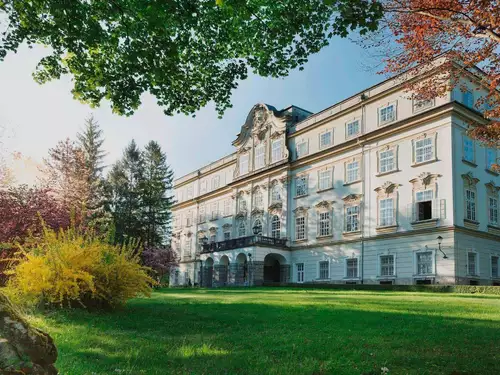
Culture, History, and Retreat at Hotel Schloss Leopoldskron
Just a few minutes removed from the bustle of the city lies Schloss Leopoldskron – a place that early on became an intellectual counterpoint to the grand festival stages, today ranking as one of Salzburg’s most culturally significant historic hotels. Intellectuals and artists gathered here, including no less a figure than Max Reinhardt himself.
The theater pioneer and co-founder of the Salzburg Festival viewed art as an all-encompassing experience, leaving a lasting imprint on Leopoldskron. With the creation of the Max Reinhardt Library, he gave this Schloss new intellectual life. Inspired by the Abbey Library of St. Gallen, he consciously transposed its atmosphere to Salzburg – not as a copy, but as a spatial idea adapted to the different proportions and lighting conditions. The result is a place where thought, the collection, and atmosphere meld together architecturally.
The Schloss and library, nestled between parkland and a small lake, form a quiet and cohesive whole. Nothing feels isolated; interior and exterior spaces flow seamlessly into one another, and even strolls become architectural experiences in their own right. Leopoldskron thus embodies the very qualities that were also central to Clemens Holzmeister: proportion, atmosphere, and context. Proximity to the city opens cultural pathways, while retreat within the palace produces calm and depth. From here, Salzburg is not merely visited, but consciously experienced – as a city of architecture, art, and subtle transitions.


St. Anton am Arlberg: The Parish Church of St. Anton in a Dialogue across Time
The Parish Church of St. Anton am Arlberg dates back to a Baroque structure built in 1698 and has shaped the village’s appearance for centuries. In 1932, Clemens Holzmeister carefully enlarged and expanded the church, combining the Baroque building fabric with new architectural elements. A new, lower tower was deliberately introduced as a distinct accent without overshadowing the historic character. His design is considered an early example of typological monument preservation, in which old and new do not stand in opposition but enter into a sensitive, contemporary dialogue.
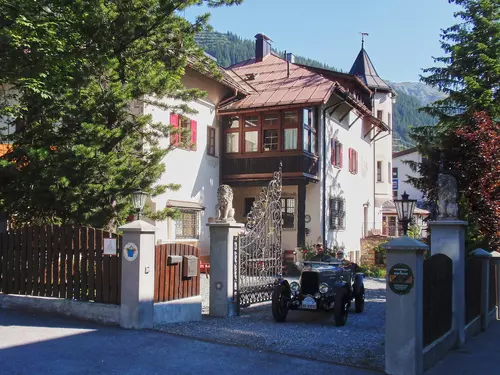
Das Bergschlössl between History and the Present
Slightly above the village lies Das Bergschlössl – a small, historic boutique hotel where we see an extension of this same attitude. Here, too, tradition and contemporary spirit meet not as opposites but as natural complements. Reduced in form, calm in atmosphere, and focused on essentials, the house forms a deliberate counterpoint to the dynamism of the village below.


Dürnstein: Clemens Holzmeister and His Love for the Wachau
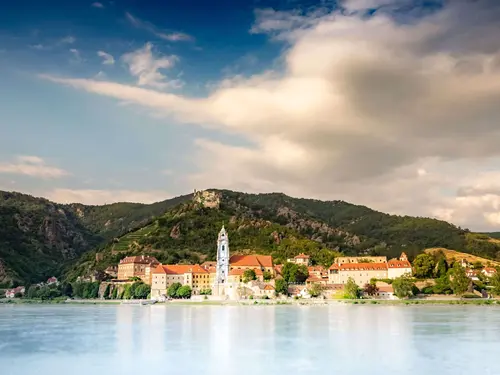
Dürnstein is not a place of grand monuments, but one of quiet transitions. The Danube, castle ruins, vineyards, and historic houses form a dense cultural landscape in which architecture and nature are inseparably intertwined. In his artistic work Dürnstein (1968, Albertina Vienna), Holzmeister explored the town through drawing, attentive to scale, topography, and the relationship between built spaces and landscapes. The work reveals how deeply the interplay between landscape and architecture occupied him – and how important places were to him that function as a cohesive whole.
It was likely this very quality that shaped Holzmeister’s personal connection to the Wachau. He returned here time and again, celebrating many of his birthdays in the region, often surrounded by students and companions.
Hotel Richard Löwenherz in the Rhythm of the Wachau
Situated directly on the Danube, Hotel Richard Löwenherz integrates naturally into this remarkable cultural landscape. The former monastery draws its character from its setting, its history, and the sense of calm it radiates. Walls, courtyards, and gardens feel organic rather than staged. Architecture is not explained here, it unfolds – through walking, observing, and lingering.
Dürnstein represents the quiet conclusion of this journey. Far from a classic city trip, but still a place where Holzmeister’s understanding of architecture again becomes clearly tangible.

This journey shows how city travel can be reimagined – not through speed, but through connections. Not through quantity, but through depth. In the footsteps of Clemens Holzmeister – and on the path toward a more conscious experience of cities, architecture, and extraordinary houses.
Header photo: Clemens Holzmeister Stairway in Salzburg (c) Wikimedia Commons, CC0 1.0 (public domain)
Photo credits for the article preview page: Otto Skall (public domain)